

Cloud development is changing faster than before. Today’s teams are not just dealing with complicated setups or how to launch their programs. The real difficulty now is in creating, expanding, and improving applications smartly.
This is where AWS Kiro comes in.
Instead of seeing artificial intelligence as something extra, AWS Kiro presents a fresh way of thinking. It includes AI right in the process of development, helping developers, DevOps workers, and companies shift from doing things by hand to smarter cloud engineering.
In other words, AWS Kiro shows a change from just building infrastructure to working together with intelligence.
What is AWS Kiro?
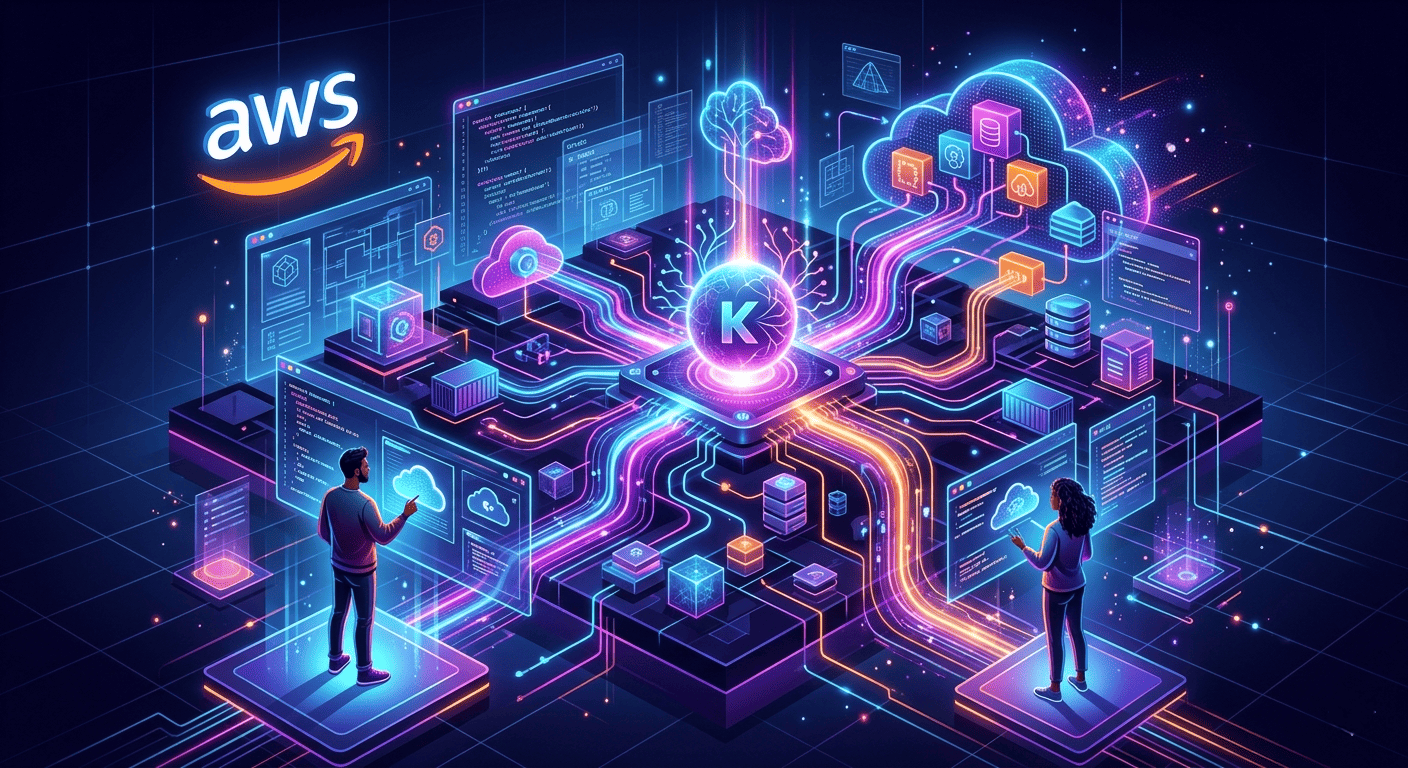
AWS Kiro is an artificial intelligence-powered cloud development framework.
Designed to accelerate the development, deployment, and management of applications on the AWS ecosystem, Developers could use artificial intelligence assistance instead of manually setting up services, writing repetitive scripts, or going through problems one step at a time.
- Create cloud configurations.
- Make infrastructure installation automatic.
- Optimize deployment workflows.
- Boost the efficiency of development.
- Lower the complexity of operations.
As a result, teams devote more time to generating commercial value and less time to maintaining infrastructure.
The Importance of AWS Kiro
Adoption of the cloud has grown exponentially over the past ten years. More flexibility, though, also produced fresh challenges:
- Intricate designs.
- Integration of multiple services.
- Increasing cloud expenses.
- Extended deployment cycles.
- A lack of expertise in DevOps automation.
Traditional cloud workflows frequently need an extensive understanding of several AWS services. Keeping efficiency as firms grow becomes more challenging.
By integrating AI-assisted decision-making into cloud operations, AWS Kiro bridges this gap.
“What is the best way to build this?” is now the question teams may ask, rather than “How do we set this up?”
Key Features of AWS Kiro
1. Infrastructure Automation Driven By AI
Based on application needs, AWS Kiro helps developers create and implement infrastructure automatically.
Consequently:
- The installation time is greatly reduced.
- Human configuration errors lessen
- Infrastructure becomes uniform
This enables companies and startups to more rapidly build production-ready settings than at any point in history.
2. Cloud Assistance and Smart Code
Developers often switch between coding and cloud configuration tools. This friction is eliminated by AWS Kiro.
Kiro can do the following by knowing the context of the application:
- Suggest AWS services.
- Recommend changes to the architecture.
- Create deployment templates.
- Help in troubleshooting workflows.
As a result, development is far more efficient and straightforward.
3. More intelligent DevOps Procedures
Modern DevOps is built on continual delivery, monitoring, and automation. By utilizing AI insights, AWS Kiro improves these workflows.
Groups gain from:
- Suggestions for automated CI/CD.
- Directions for enhancing performance.
- Forecasting scaling methods.
- Quicker release cycles.
In the end, businesses move toward continuous intelligent delivery as opposed to just continuous integration.
4. Cost Consciousness and Integrated Optimization
Cloud expenditures frequently increase without being seen. By analysing usage patterns and recommending enhancements, AWS Kiro provides proactive optimization.
It may, for instance:
- Make a recommendation to properly size resources.
- Identify underused services.
- Boost the staff’s output.
Consequently, cloud management becomes a strategic resource as opposed to just a daily task.
How AWS Kiro Changes the Developer Experience
Historically, developers interacted with the cloud through dashboards, scripts, and documentation. While powerful, these methods demanded significant manual effort.
AWS Kiro changes the experience entirely.
Now, developers collaborate with AI as a Cloud Engineer who helps plan, build, and optimize applications.
The result is:
- Faster onboarding for teams
- Reduced operational overhead
- Accelerated innovation cycles
- Improved developer productivity
In many ways, AWS Kiro represents the next natural evolution after Infrastructure as Code and DevOps automation.
Real-World Use Cases of AWS Kiro
Companies in different fields can use AWS Kiro to upgrade their cloud services.
Media & Digital Platforms
Easily manage sudden increases in online visitors, set up automatic deployments, and improve video streaming systems.
Startups & SaaS Companies
Bring products to market more quickly without needing big DevOps teams.
Enterprises
Make cloud settings more uniform while enhancing control and the ability to grow.
AI & Data Platforms
Speed up testing by automating the setup of infrastructure for machine learning tasks.
AWS Kiro vs Traditional Cloud Development
Traditional Approach |
AWS Kiro Approach |
|
Manual configuration |
AI-assisted automation |
|
Reactive troubleshooting |
Predictive optimization |
|
Tool-heavy workflows |
Unified intelligent experience |
|
High learning curve |
Guided development |
|
Slow deployments |
Accelerated releases |
Clearly, AWS Kiro moves cloud development from manual engineering to intelligent orchestration.
The Future of AI-Powered Cloud Engineering
Artificial intelligence has moved beyond just data analysis or virtual assistants. It is starting to be the foundation for how new software is created.
AWS Kiro shows a future where:
- Systems create their own designs
- Installations get better on their own
- Programmers can concentrate on new ideas instead of fixing old ones
As more companies start to use AI as their main technology, services like AWS Kiro will be key in shaping how software is made over the next ten years.
Why Businesses Should Pay Attention
Businesses that start using AI-based cloud systems early can get big benefits over their competitors:
- They can get their products out faster.
- They can save money on running costs.
- They can grow more easily.
- They can increase how much work their engineers can do.
Most importantly, they make sure their technology is ready for future changes in the digital world.
Conclusion
AWS Kiro is not just another feature from AWS. It shows a change in how we think about cloud computing.
Now, instead of having to manage everything by hand, companies can create with smart systems that keep learning, improving, and speeding up the development process.
The next generation of cloud development isn’t only about automation.
It involves artificial intelligence, adaptability, and smart technology.
AWS Kiro is playing a big role in making that change happen.