

The entertainment industry has always balanced innovation with cautious risk.
For years, studios, broadcasters, and production companies used market research, audience surveys, and gut impressions to help them to choose what material to create next. Occasionally, those bets developed into worldwide wonders. In other cases, even magnificent performances vanished without a trace.
Still, the regulations are changing as we speak.
Today, media companies are using artificial intelligence to better understand audience preferences, analyze trends, and gain deeper viewer insights. Instead of relying only on gut instinct, businesses can now make smarter decisions using data-driven insights.
This raises an important question: Can AI truly predict the next hit show?
While AI cannot guarantee success, it can significantly improve the chances. Moreover, when combined with Amazon Web Services (AWS) capabilities, AI becomes a powerful game-changer in media analytics.
The Challenge with Conventional Content Decision-Making
Developing effective content has always posed difficulties.
A producer might feel that a narrative is intriguing. A director could have confidence in the performances of the actors. Marketing departments may predict high levels of interaction. Nevertheless, audience reactions can still be erratic.
Why is that? It is because audience behavior is in a state of constant change.
Viewer tastes fluctuate due to:
- Cultural Dynamics
- Social Media Impact
- Seasonal Habits
- Local Preferences
- Competition Among Platforms
- Content Exhaustion
Consequently, past achievements do not ensure future success anymore.
For instance, a popular genre from last year might face challenges today. Likewise, a specialized narrative can rapidly become a sensation in popular culture overnight.
This unpredictability presents a significant obstacle for media companies.
They require solutions to essential inquiries such as:
- Which genres are on the rise?
- Which actors enhance engagement?
- At what point are viewers losing interest?
- Which demographics favor short-form versus long-form material?
- What content is poised to become trending next?
This is where AI-powered analytics revolutionizes the landscape.
How Artificial Intelligence Helps to Estimate Public Taste
AI excels in finding patterns in huge datasets that are not immediately obvious.
These datasets in the media industry comprise:
- Viewing Experiences for the Viewer.
- Research How Humans Act.
- Click Rates.
- Rates of Achievement.
- Rewind and Stop Patterns.
- Device Preferences.
- How to Manage Subscriptions.
- Public Perception.
On their own, these signals might appear trivial. Together they provide a powerful narrative.
By analyzing millions of interactions, people could overlook insights that artificial intelligence models can reveal.
AI could find, for instance:
- Fast-paced thrillers with short episodes are preferred by audiences between the ages of 18 and 25.
- Viewers in some areas have a stronger interest in dubbed content. Some release timings raise first-day viewing levels.
- Certain emotional storylines lead to more completeness.
This leads to an improved comprehension of what really resonates with their audience among content producers. Rather than just guessing, they may develop intelligent strategic decisions.
Media Analytics and the AWS Edge
AI needs three main components:
- Large-Scale Data Processing.
- Expandable Infrastructure.
- Rapid Machine Learning Deployment.
AWS excels in this area. Amazon Web Services
Media businesses may utilize cloud-native tools from AWS to simplify real-time insights, AI training, and large-scale analytics.
Media companies may securely and effectively ingest, store, process, and analyze petabytes of audience data using AWS.
The following are some of the most important AWS services that support media analytics:
Amazon S3 for Data Storage
Amazon S3 is used by Amazon Web Services to store enormous media datasets, video assets, logs, and audience behavior data with outstanding durability and scalability.
This establishes a data lake in one location for analytics.
Amazon Redshift for Analytics
Teams can execute complicated analytical queries on huge datasets in a matter of seconds using Amazon Redshift.
Businesses may identify consumption patterns more quickly with its assistance.
Amazon SageMaker for ML (Machine Learning)
At a large scale, data scientists can create, train, and deploy machine learning models using Amazon SageMaker. Predictive intelligence is created here.
Models may forecast:
- Audience Churn.
- The Appeal of Content.
- Relevance of Recommendations.
- Advertising Effectiveness.
Amazon Personalize for Personalized Recommendations
Personalize provides highly tailored content suggestions. Consider the streaming service’s “Because you watched…” area.
These recommendations significantly increase engagement and retention.
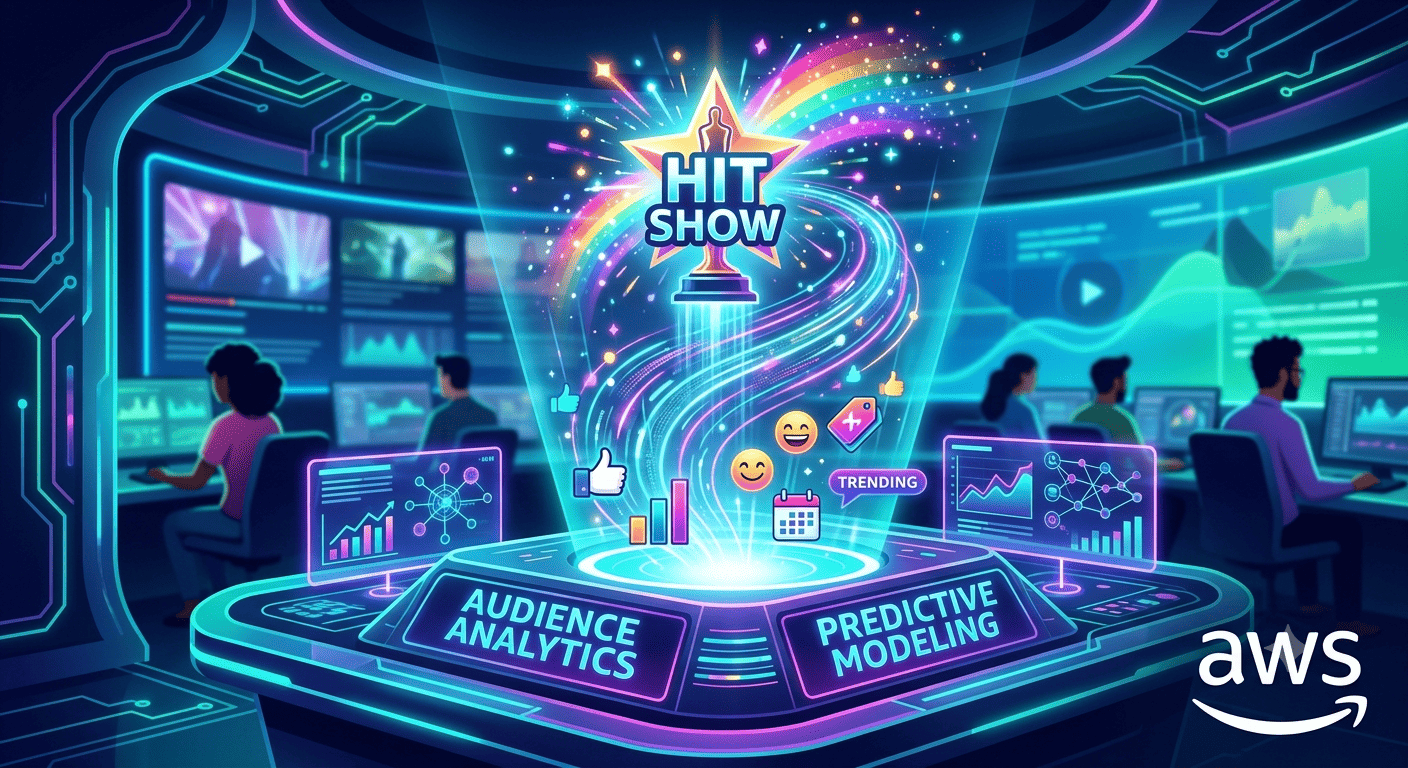
How It Actually Works: From Data to Predictions
It is not magic to predict a successful television program. It’s a multi-layered procedure.
Step 1: Get Audience Indications
Each communication generates data.
When a viewer:
- Begins a Performance.
- Skips an Intro.
- Stops in the Middle of a Scene.
- After Episode 2, it ends.
- Watches an entire season back-to-back.
That behavior turns into a helpful indicator.
Step 2: Examine Behavioral Tendencies
AI models analyze relationships across millions of users.
The system recognizes:
- Clusters of Similar Viewers.
- Genres with High Retention.
- Triggers for drop-off.
- Boosters that Increase Engagement.
Patterns are beginning to appear.
Step 3: Generate Predictive Scores
For every content asset, forecasts are made based on probability.
As an illustration:
- Potential Completion Rate: 84%
- Predicted Binge Rate: 68%
- High Churn Reduction Effect
- High-Medium Viral Potential Score
Investments are prioritized using these results.
Step 4: Optimize in Real Time.
The continuous optimization is where the actual strength is found.
AI continues to learn.
Models evolve as audience behavior changes.
This implies that forecasts get better over time.
Is It Possible for AI to Actually Forecast a Blockbuster?
Here’s the truth. AI can anticipate cultural enchantment, not possibility.
No algorithm can fully encompass cultural timing, human emotion, or the unpredictability of a virus.
Nobody had predicted the spectacular success of programs such as:
- Stranger Things
- Squid Game
- Money Heist
These became more than shows. They became global conversations. Still, AI helps reduce uncertainty.
Instead of asking: “Will this definitely succeed?”
Media leaders now ask: “What does the data suggest, and how can we improve success probability?”
That shift is enormous. AI does not replace creativity. It strengthens strategy. Creativity builds the story.
AI helps ensure the right audience finds it. That combination is powerful.
Why Media Companies Are Making AI Investments Right Now?
Streaming competition has gotten fiercely more intense.
Platforms are fighting for:
- Viewers’ Focus.
- Retention of Subscribers.
- Revenue from Advertising.
- Market Differentiation.
Simultaneously, content creation expenses keep going up.
Making one premium series might cost millions.
That translates to substandard material. Decisions cost money.
Enabling AI lowers this risk by:
- Improved Content Investment Choices.
- Better Audience Identification.
- Increased Participation Rates.
- More Effective Monetization Techniques.
AI converts data into corporate intelligence, in other words.
How Whizzy Geeks Supports Media Companies with AWS
As an AWS-focused cloud solutions supplier, Whizzy Geeks enables media companies to realize the complete power of AI-driven analytics.
We assist companies in:
- Design Adaptable Cloud Data Pipelines.
- Move Media Operations to AWS.
- Apply Artificial Intelligence & Machine Learning Models.
- Improve the Infrastructure for Delivering Material.
- Improve Performance while cutting Cloud Expenses.
Whether you are a streaming service, digital broadcaster, OTT startup, or production business, the objective is always the same:
Change audience information into useful understandings.
The winners in the current media scene are producing material, not only
They are better than anyone else at understanding consumers.
Final Thoughts
Can artificial intelligence therefore foretell the following success? Not quite.
It can, however, reveal signals that were previously unnoticed. It may identify patterns often missed by humans and help media businesses make faster, smarter, and more profitable decisions.
AI, most importantly offers companies something quite useful: an unstable market’s clarity.
Creativity by itself won’t define the direction of entertainment. Not only by data. Companies that effectively integrate both will own it.
That future is here now thanks to AWS-powered media analytics.
Want Whizzy Geeks to help you unlock AI-powered media analytics on AWS?
In today’s fast-evolving media landscape, data-driven decisions are key to staying ahead. From predicting viewer preferences to optimizing content performance, AI can help media companies drive smarter growth.
As an AWS Advanced Tier Partner, Whizzy Geeks helps media businesses leverage AI and AWS to turn audience data into actionable insights, improve engagement, and maximize content success.
Drop us an email at [email protected] for more information.