

Viewers are not extremely tolerant of poor video quality, unforeseen blackouts, or buffering wheels in the streaming-first environment of today. They want perfect playback every time, regardless of whether they are viewing the newest blockbuster series, a breaking news report, or a live sports final. A short period of downtime could lead to lost subscribers, a bad brand image, and a big drop in revenue.
Consequently, OTT companies cannot rely on conventional single-region infrastructure. Rather, they need cloud systems that still provide access even if a whole area suffers from interruptions.
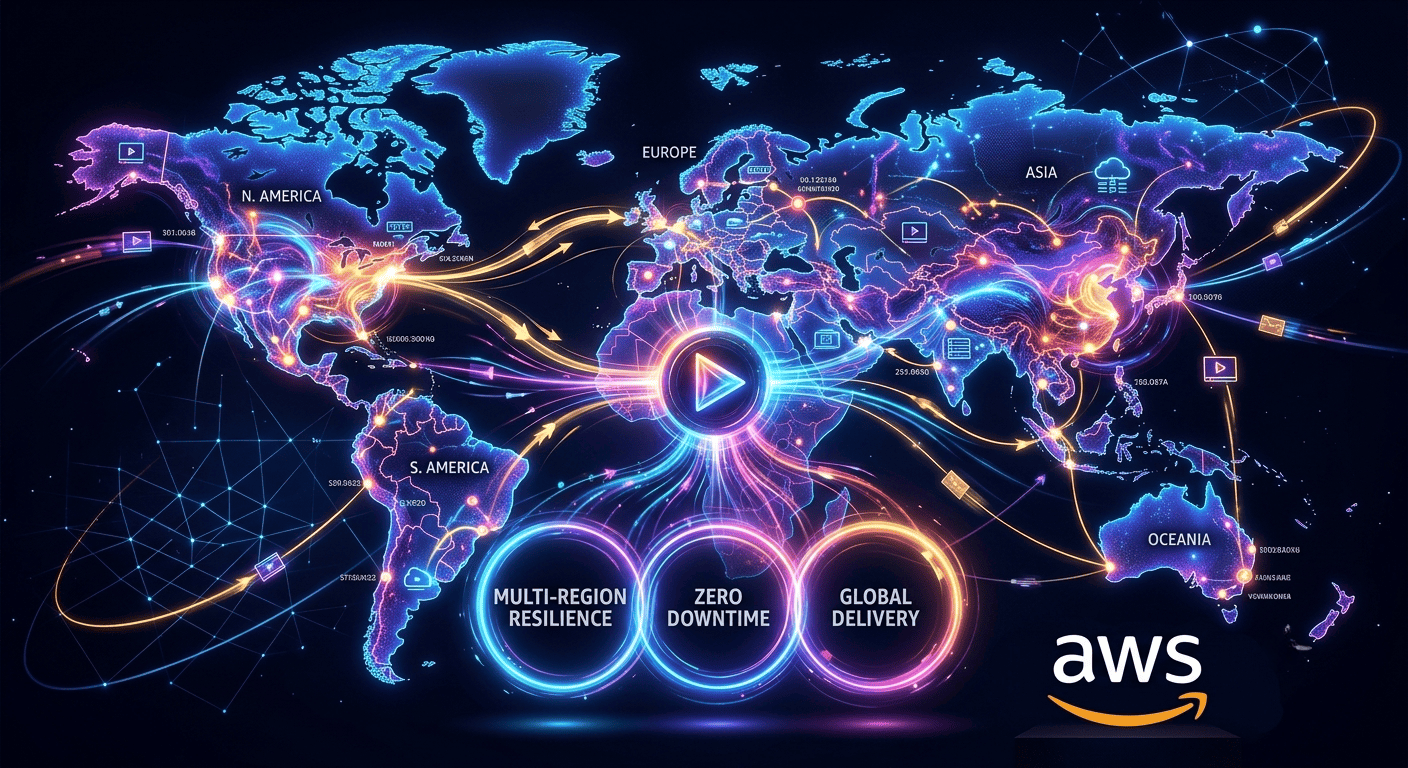
Multi-region design powered by AWS really shines here. By distributing work among various AWS Regions, OTT networks may have continuous streaming for consumers all around, low latency, perfect failover, and great availability.
In this course, we will cover how to design a resilient multi-region OTT platform on AWS that guarantees actual zero downtime while preserving scale performance.
Why Zero Downtime is Crucial for OTT Platforms
Streaming services function in a setting where each moment is vital.
Consider a live cricket match drawing in millions of viewers at once. If the main system fails during the final moments, audiences will not wait for a fix. They will quickly turn to an alternative platform.
This is why contemporary OTT companies prioritize constant availability over reactive solutions.
A zero-downtime framework allows companies to:
- Provide continuous live and on-demand broadcasts.
- Safeguard subscription income.
- Preserve audience confidence.
- Minimize service interruptions.
- Expand effortlessly during high-traffic periods.
- Fulfil worldwide availability standards.
As the acceptance of OTT continues to rise, having resilient infrastructure has evolved into a competitive edge rather than merely a technical necessity.
Why Single-Region Deployments Create Business Risks
Many growing OTT platforms initially launch from a single cloud region because it’s simpler and more cost-effective. However, as audience size increases, this architecture introduces several challenges.
Common risks include:
- Regional cloud outages.
- Network congestion.
- Increased latency for international viewers.
- Limited disaster recovery capabilities.
- Higher recovery time during failures.
- Infrastructure bottlenecks during major events.
Even a highly reliable cloud region cannot eliminate every possible disruption. Therefore, building redundancy across regions is essential for uninterrupted service.
The Foundation of a Multi-Region OTT Architecture on AWS
A resilient OTT platform isn’t built around a single server or availability zone. Instead, every critical component is distributed across multiple AWS Regions.
Below is a simplified architecture flow.
Content Ingestion
│
▼
AWS MediaLive
│
▼
AWS MediaPackage
│
▼
Amazon S3 (Cross-Region Replication)
│
▼
Amazon CloudFront
│
▼
Global Viewers
Meanwhile, application services, APIs, user authentication, databases, and monitoring also operate across multiple regions, ensuring the platform continues functioning even during infrastructure failures.
Core AWS Services for Zero Downtime Streaming.
1. CloudFront for Global Content Distribution by AWS.
Users can access video from the nearest location rather than directly from the origin server since Amazon CloudFront caches streaming material at edge sites around the world.
Advantages consist of:
- Reduced Latency.
- The startup of a movie is quicker.
- Less Buffering.
- Lower load at origin.
- Enhanced global performance.
Therefore, viewers may watch material more smoothly regardless of where they are in the world.
2. Cross-Region Replica via Amazon S3
One of the most important components of any OTT platform is the video asset.
Automatic copying of content saved in one AWS Region to another is made possible using Cross-Region Replication (CRR).
This offers the following:
- Highly resilient
- Backup in many areas
- Enhanced disaster recovery
- Content that is available nonstop
Viewers may access the duplicated material from a different area even if one region becomes unavailable.
3. Live Streaming with AWS MediaLive
Unpredictable traffic surges are produced by live events. Broadcast-grade live video encoding is offered by AWS MediaLive, which scales automatically to meet demand.
It supports:
- Multiple Bitrate Outputs.
- Dynamic bit rate streaming.
- High-availability pipelines.
- Scaling for live events.
Additionally, operating MediaLive over several regions increases service continuity in the event of regional failures.
4. AWS MediaPackage Content Packaging
Various gadgets use several streaming protocols.
For instance, AWS MediaPackage automatically generates content for the following formats:
- HLS
- DASH
- CMAF
Since packing takes place on demand, material reaches consumers in the most suitable format without the need for several stored versions.
5. Elastic Load Balancing (ELB)
One application server shouldn’t be employed to manage traffic.
Elastic Load Balancing makes sure applications keep responding by distributing requests among working instances even if a server fails.
Together with Auto Scaling, this creates an environment ready for sudden surges in traffic.
6. Smart DNS Failover for Amazon Route 53
Often, DNS defines how quickly people recover from disruptions. Amazon Route 53 routinely checks endpoint health.
If one area goes down, traffic is quickly redirected to another good location. Failover happens fast and without interruption, so customers can stay connected without knowing any changes in the underlying setup.
Database Plan for Multiple Regions
Video delivery is just one aspect of streaming.
Highly available databases are necessary for user accounts, subscriptions, recommendations, watch history, and playback progress.
Possible components of a robust database strategy are:
- Replication across several regions.
- Automated backups.
- Replicas of a database for reading.
- International Databases.
- Continuous synchronisation.
This guarantees that consumers may pick up where they left off, even after regional failovers.
Automating Disaster Recovery Design
Manual intervention should never be necessary for disaster recovery.
Instead, current OTT systems automate recovery processes by:
- Health Monitoring.
- Automation of Infrastructure.
- Replication Continuously.
- Failover Automatically.
- IaC, Infrastructure as Code.
- Regular Disaster Recovery Testing.
Consequently, operational complexity decreases while recovery periods are substantially reduced.
Scaling during Peak Streaming Events
The traffic patterns on OTT platforms are exceedingly volatile.
Within minutes, millions of viewers might be simultaneously drawn to a championship final or a movie premiere.
Through: AWS assists platforms in getting ready.
- Automatic Computation Scaling
- Elastic Network
- Distributed content delivery
- Administrated Streaming Solutions
- Event handling without servers
As a result, infrastructure naturally grows as viewers’ demand increases.
The Architecture must include security.
Without strong security, high availability is not very useful. OTT services ought to protect each stage of the streaming pipeline using:
- Access and Identity Management.
- Rest encryption.
- During Transit Encryption.
- Web Application Firewalls (WAFs).
- Protection against DDoS.
- Secure API Authentication.
- Monitoring of threats on an ongoing basis
Security and resiliency should constantly evolve together.
Live Monitoring of Each Component
Every piece of sturdy infrastructure needs constant monitoring.
Engineering teams may use comprehensive monitoring to identify performance degradation before viewers encounter outages.
Among the most important metrics are:
- Availability of Streams
- Lag at startup
- Buffer ratio
- CDN cache hit percentage
- Rate of error
- Health of infrastructure
- Performance of a database
- The distribution of traffic by region
Teams can respond before small issues turn into major outages by actively monitoring them.
The Advantages of a multi-region OTT platform for companies
Aside from technical dependability, investing in multi-region infrastructure provides benefits.
Organisations gain from:
- Increased Spectator Enjoyment.
- Higher Subscriber Retention.
- Enhanced Global Performance
- Enhanced Operational Consistency
- Lowered Operational Risk
- Quicker Disaster Recovery
- Increased Scalability
- More Established Brand Name
Resilience is eventually a business plan rather than just an engineering goal.
Final Thoughts
No one AWS service or setup results in zero downtime. Rather, it is the result of careful design, ongoing monitoring, automated recovery, and smart worldwide delivery.
OTT providers can offer very available streaming experiences that stay quick, safe, and dependable under almost any situation by combining services like Amazon CloudFront, Amazon S3, AWS MediaLive, AWS MediaPackage, Elastic Load Balancing, and Amazon Route 53.
Investing in a multi-region AWS design is no longer voluntary, as audience expectations keep growing. In a more cutthroat streaming scene, it’s the cornerstone for providing continuous pleasure, preserving income, and establishing long-term consumer confidence.
Want Whizzy Geeks to build a zero-downtime OTT platform for your business?
Our AWS-certified cloud experts design secure, scalable, and multi-region streaming architectures that keep your content live, your viewers engaged, and your business ready for every traffic surge. Contact us today for a free AWS architecture consultation.
Drop us an email at [email protected] for more information.