
Video streaming is more in demand worldwide than it has ever been. Businesses are investing in OTT (Over-the-Top) platforms to interact with audiences without using conventional television networks, in fields like education, entertainment, healthcare, sports, and business communications.
Nonetheless, a lot of companies think that starting an OTT platform is a time-consuming and expensive operation. Fortunately, that is no longer the case.
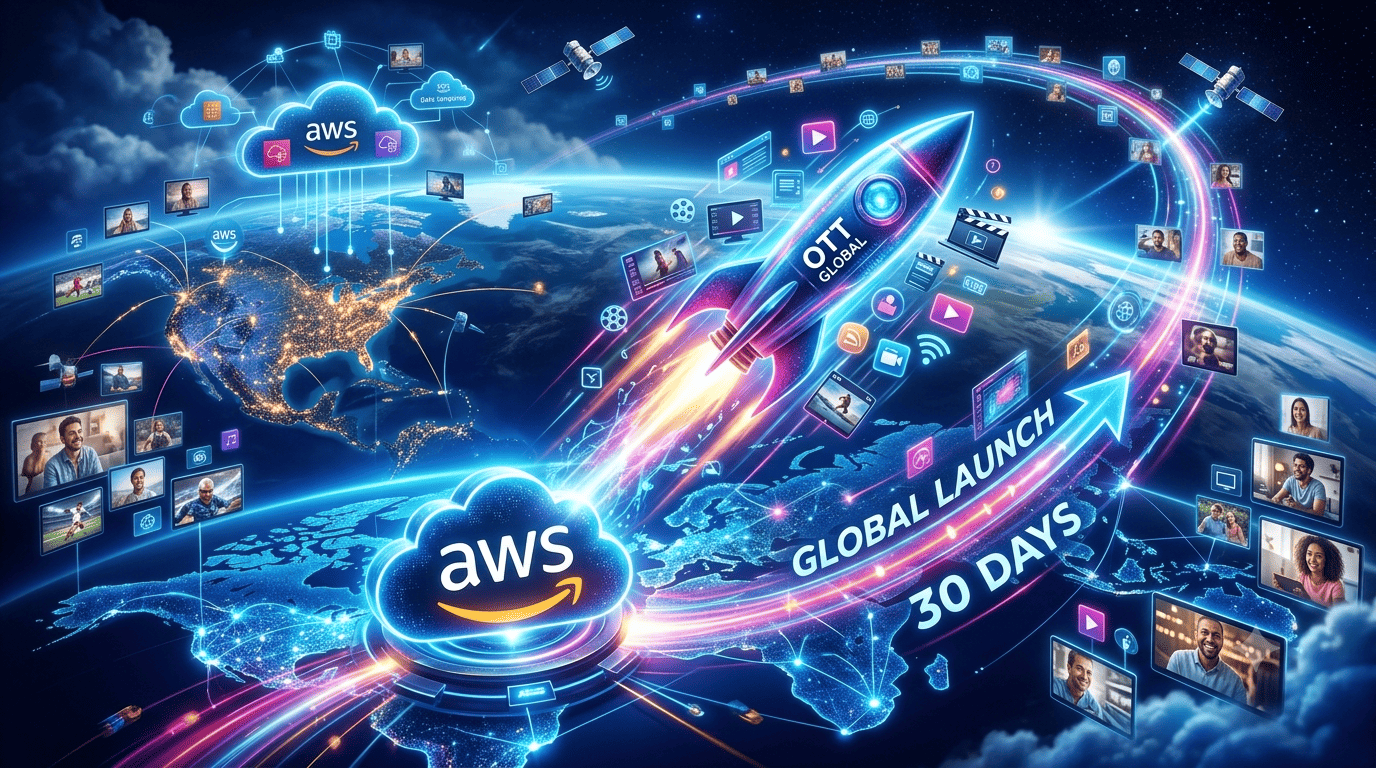
Without having to invest in expensive on-premises infrastructure, the appropriate cloud architecture and AWS services may allow enterprises to create, deploy, and grow a secure OTT platform in as little as 30 days.
With an emphasis on affordability, worldwide performance, security, and scalability, this guide presents a realistic strategy for creating an OTT platform using AWS.
Why is AWS the cloud platform that OTT services choose?
Streaming services encounter unusual hurdles. They need to be able to handle massive video files, accommodate millions of viewers at once, preserve little latency, and safeguard valuable material against theft. Additionally, during new content releases or live events, user traffic may change significantly.
With a full ecosystem built especially for media and entertainment applications, AWS overcomes these obstacles.
Some of the major advantages are:
- A worldwide infrastructure with many AWS Regions and Edge Locations.
- Video processing with high performance.
- Content delivery with low latency.
- Security at the enterprise level.
- Automatic scaling during traffic spikes.
- Pay-as-you-use pricing.
- AI and analytics tools for customized viewing experiences.
Thus, companies may concentrate on producing content while AWS oversees the infrastructure.
Roadmap for a 30-Day OTT Launch
Starting fast does not imply sacrificing quality. Rather, a well-thought-out execution strategy ensures that every important element is constructed appropriately.
Week 1: Establish the Cloud Infrastructure
Every effective OTT platform starts with a safe and scalable cloud infrastructure.
First week teams usually:
- Create AWS infrastructure.
- Set up networking.
- Establish a Virtual Private Cloud (VPC).
- Add Identity and Access Management (IAM).
- Establish security groups.
- Create logging and monitoring systems.
- Establish development and production environments.
This stage lays the groundwork for every platform element to come.
Week 2: Video Storage and Processing
The next phase is all about getting videos ready for streaming.
Unedited videos typically need to be converted into multiple resolutions to fit different device and internet speed needs.
A typical process includes:
- Uploading Videos
- Automatic Conversion
- Creating Thumbnails
- Generation of Metadata
- Reliable Storage
- Packaging Content
Whether viewers are using desktop PCs, smart TVs, tablets, or mobile phones, this configuration ensures they have a perfect viewing experience.
Week 3: Streaming, CDN, and User Experience
Once the material is created, the focus shifts to presenting it optimally.
AWS uses edge nodes all around to distribute content instead of streaming videos directly from one server. Viewers gain from faster loading and less buffering, independent of their location.
Teams usually apply at this phase:
- Streaming of Video via APIs.
- Login Systems for Users.
- Oversight of Subscriptions.
- Search Functions.
- Seeing the Past.
- Customized Recommendations.
- Multi-device Support.
- CDN Integration.
Performance reviews are concurrently done to find any problems before the platform is formally introduced.
Week 4: Evaluation, Safety, and Worldwide Release
Before the release, thorough evaluation guarantees that the platform functions dependably in actual usage scenarios.
The concluding week encompasses:
- Load Testing
- Safety Assessment
- Backup Setup
- Emergency Recovery Strategy
- Efficiency Enhancement
- Expense Reduction
- Live Deployment
- Domain Name System setup
- Monitoring Dashboards
After these activities are finished, the platform becomes available to users globally.
Essential AWS Services for an OTT Platform
AWS offers a rich portfolio of services that work together to create a modern streaming platform.
Requirement |
AWS Service |
|
Video Storage |
Amazon S3 |
|
Video Processing |
AWS Elemental MediaConvert |
|
Live Streaming |
AWS Elemental MediaLive |
|
Content Delivery |
Amazon CloudFront |
|
API Management |
Amazon API Gateway |
|
Backend Compute |
AWS Lambda / Amazon ECS |
|
User Authentication |
Amazon Cognito |
|
Database |
Amazon DynamoDB / Amazon RDS |
|
Monitoring |
Amazon CloudWatch |
|
Security |
AWS WAF, AWS Shield, IAM |
| Analytics |
Amazon QuickSight |
Taken together, these services provide a very resilient and available OTT ecosystem.
Making an End-to-End OTT Workflow
A successful streaming service implements a smooth process that transitions from uploading content to playback by viewers.
The typical sequence is as follows:
Upload content → Process video → Store securely → Package content → Distribute via global CDN → Authenticate viewers → Play video → Collect analytics
Since each element of this process is automated, there is minimal operational burden while the experience for users remains consistently positive.
Security Should Never Be an Afterthought
High-quality video content is an asset. Therefore, securing it is as crucial as delivering it effectively.
AWS provides various security features, which include:
- Comprehensive Encryption
- Safe User Authentication
- Access Control based on user roles
- Web Application Firewall (WAF)
- Protection against DDoS attacks
- Token-based content distribution
- Secure access to APIs
- Continuous watch of threats
While guaranteeing compliance with industry standards, these features significantly reduce security risks.
Reaching Millions of Viewers
The capacity to automatically scale is one of the biggest benefits of AWS.
Imagine millions of people seeing a major live sports event or the debut of a new series in a matter of minutes.
AWS automatically adjusts compute resources according to demand, rather than provisioning servers by hand. As a result, companies only pay for the resources they use, and viewers may continue streaming without interruption.
This elasticity does away with the need to invest in pricey gear that might not be used enough during typical traffic.
Achieving Performance Without Overspending
Global deployment shouldn’t result in excessive cloud expenditures.
Organizations may optimize expenditure by:
- Utilize lifecycle rules to archive videos.
- Automatic Scaling
- Choosing a Serverless Architecture
- Enhancing Video Encoding Profiles
- Utilizing CloudFront for Caching
- Maintaining Consistent Use Monitoring
- Putting Up Smart Storage Layers
A smart approach to cost control guarantees the long-term viability of operations.
Improving the Watching Experience With AI
Modern OTT platforms extend beyond simple video streaming.
AWS enables intelligent features such as:
- Personalized Content Recommendations
- AI-Powered Search
- Automated Subtitle Generation
- Speech-to-text Conversion
- Viewer Behavior Analytics
- Content Moderation
- Predictive Audience Understanding
These features enable companies to make data-driven content choices while increasing user interaction.
Common Problems and How AWS Addresses Them
Challenge |
AWS Solution |
|
High traffic spikes |
Auto Scaling |
|
Video buffering |
Amazon CloudFront CDN |
|
Slow transcoding |
AWS Elemental MediaConvert |
|
Security threats |
AWS Shield + AWS WAF |
|
Global content delivery |
Worldwide Edge Locations |
|
Infrastructure management |
Managed AWS Services |
|
Cost control |
AWS Cost Explorer & Budgets |
Rather than creating these skills from the ground up, businesses can use AWS’ managed services to hasten deployment and lower operational complexity.
Who Can Gain from an AWS-Based OTT Platform?
No longer restricted to entertainment corporations are OTT platforms.
Businesses in several industries are embracing video streaming to better grab their audience’s attention.
Among these are:
- Media and Entertainment
- Universities & Colleges
- Providers of Business Training
- Sports Organizations
- Medical Websites
- Religious Institutions
- Fitness Business
- Companies that Organise Events
- News Reporters
- E-learning Companies
AWS offers the agility to handle many corporate models, whether the aim is subscription-based streaming, live broadcasting, or video-on-demand.
Conclusion
Starting a worldwide over-the-top service no longer calls for a lot of time or money investment in equipment. Using managed cloud technology, system automation, and a worldwide content delivery framework, AWS enables organizations to build a safe, scalable, and effective streaming service in as little as 30 days.
Moreover, AWS enables companies to begin modestly, adapt to shifting demands, and control prices as their audience expands. The proper cloud infrastructure sets the foundation for continuous prosperity, whether you’re launching a subscription-driven content service, live streaming sessions, or on-demand video options.
Those companies that offer great viewing experiences while maintaining great performance, dependability, and security will help to define streaming going forward. AWS offers the basic resources needed to bring this goal to reality.
Want Whizzy Geeks to Launch Your OTT Platform in Just 30 Days?
Turn your streaming vision into a global success story with the power of AWS and the expertise of Whizzy Geeks, an AWS Advanced Tier Partner. From cloud architecture and video streaming infrastructure to security, scalability, and cost optimization, we help you launch a high-performance OTT platform that is built to grow with your audience.
Whether you’re planning a Video-on-Demand platform, live streaming service, or subscription-based OTT solution, our cloud specialists are ready to accelerate your journey from concept to global launch.
Drop us an email at [email protected] for more information.